

Filters
Sterling Global's 623 Collins Street will feature in Melbourne Design Week, with a conversation between Fiona Lynch and Plus Studio exploring the design thinking behind one of the CBD's most significant heritage-led developments.
The event will offer an inside look at how architecture, interiors and client vision came together to shape a cohesive outcome for the landmark Collins Street site.

Positioned at the intersection of Collins and Spencer streets, 623 Collins is anchored by the restoration of the former State Savings Bank of Victoria and the integration of a contemporary tower above.
Rather than treating heritage and new development as competing conditions, the project has been conceived as a continuous design dialogue, where past and present are resolved through a shared architectural and material language.
For Plus Studio, the approach began with a close reading of the existing buildings, their proportions, materiality and underlying architectural logic, using these elements as a framework to inform the contemporary tower.
“The heritage buildings establish a language that the new work responds to," said associate at Plus Studio, Mau Cheng.
"The tower is expressed as a modern interpretation, allowing the project to sit comfortably within its context while contributing to the evolving scale of the city.”
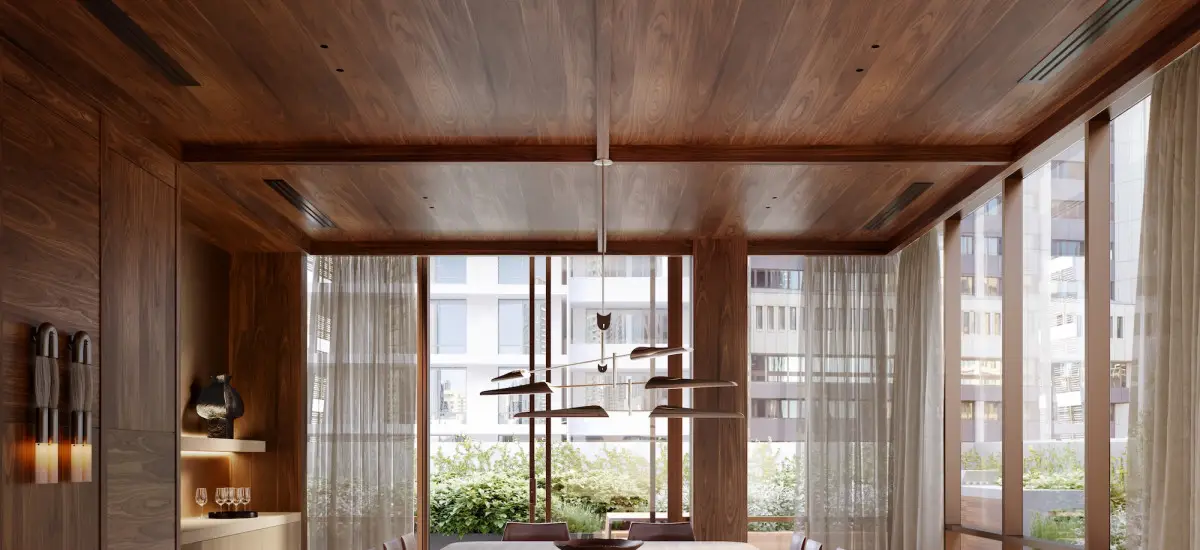
This architectural framework extends into the interiors, where Fiona Lynch Office has developed a design approach centred on atmosphere, continuity and material depth.

“Our approach was to treat the project as a point of dialogue between past and present, rather than a contrast between the two," said founder of Fiona Lynch Office, Fiona Lynch.
"The interiors sit between these conditions, creating a continuity of experience that feels grounded in the building’s heritage while expressing a contemporary identity.”
Materiality plays a central role in this transition.
A palette of tonal stone, walnut and reflective surfaces has been used to create layers of richness and variation, allowing spaces to shift subtly with light while maintaining a sense of permanence.

Across both architecture and interiors, the result is a building that moves seamlessly between scales, from the restored heritage podium to the vertical residential tower, while maintaining a consistent design language throughout.
Sterling Global director Brandon Yeoh said the project reflects a long-term commitment to design integrity as a driver of value and identity.
“623 Collins Street has been shaped by a clear and shared design vision from the outset," said Brandon.
"Rather than approaching heritage and contemporary architecture as separate ideas, the project brings them together through a unified design framework, one that considers how people experience the building over time, not just how it presents on completion.
“This level of collaboration between architecture, interiors and client is essential to delivering places that feel considered, enduring and connected to their context.”
Beyond the building itself, 623 Collins contributes to the ongoing evolution of Melbourne’s western CBD, re-establishing the site as a key gateway to Collins Street while supporting a broader shift toward design-led,mixed-use development in the city centre.
As part of Melbourne Design Week, the project will be presented through a conversation with Fiona Lynch and Plus Studio, offering insight into the design process and the role of collaboration in shaping complex urban outcomes.

623 Collins is also expected to feature in this year’s Open House Melbourne program, further positioning the development within the city’s broader architectural and cultural discourse.
Completion is currently anticipated in Q4 2029.
For more off-the-plan property news, click here.
Share this article
Sign up for new article alerts
Receive every new listing in your inbox